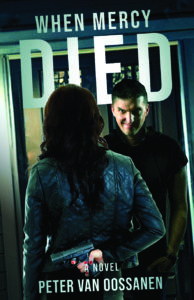
Following Literary Titan’s highly positive review of When Mercy Died and awarding him the Literary Titan’s Golden Book Award, Peter was again interviewed about the three books that comprise the Sam Stanton Trilogy.
The interview can be read below. The link to the review, for When Mercy Died. is: the review
Author Interview – Peter Van Oossanen
When Mercy Died follows an extraterrestrial raised on Earth struggling to move forward after suffering devastating loss. What do you enjoy most about crafting a trilogy?
Before answering the specific question of what I enjoyed most about crafting a trilogy, I should explain that while I was writing The Extraterrestrial, I never envisioned it as the first installment of a trilogy. At the time, I believed I was writing a standalone novel.
What surprised me most was how much I enjoyed writing fiction. As I explain elsewhere on my website in the section Inspiration, the experience exceeded all my expectations. I discovered a passion—and perhaps even a talent—for storytelling that I had never fully appreciated before. Oddly enough, my English teacher in high school had recognized this long before I did. Whenever our class was asked to write an essay or other creative piece, my work would often find its way into the school magazine, alongside only a handful of submissions from other students. Looking back, I sometimes wonder whether I should have pursued a career in writing rather than science.
It was only after completing the first manuscript and asking myself what I should write next that a realization took hold: Sam Stanton’s story was not finished. The more I reflected on the characters, the more I understood that there was still much left to explore. Sam and Michelle had shared a deep love, but they were fundamentally different people. Their relationship, while genuine, was not the final chapter in Sam’s emotional journey.
This became particularly clear when I began developing Sam’s relationship with Leona. The following passage captures how Sam himself comes to understand the difference:
“I know what you wanted to ask,” he said softly. “Let me try to answer… My love for Michelle was real. She was full of life—playful, surprising. She’d wake me up by tickling my nose with a feather. Leave little notes in my bed for me to find at night. Everyone admired her—not just for her beauty, but for her energy.”
He paused, searching for the words.
“But with you… it’s different. I never knew a connection like I have with you was possible. You’ve become a part of me. Your worries are my worries. Your hopes, my hopes. Your endeavor to rid society of criminals, my endeavor. You’re in everything I do, every thought. Michelle and I, despite the love we shared, lived separate lives. We had different passions. You and me—”
He looked into her eyes.
“—are one. Does that make sense?”
“It does,” Leona whispered. “Say no more. Just… let me replace Michelle in every way that matters, so the loss doesn’t hurt so much anymore.”
“You already have.”
As a result, I cannot say that I enjoyed writing a trilogy more than writing a stand alone novel. What I enjoyed was continuing a story that still had unresolved questions. In some respects, writing the second book was easier because the world-building had already been done and the principal characters were well established. Readers and writer alike already understood the universe in which the story unfolded.
So, what drove me forward was not the prospect of writing a trilogy, but the feeling that I had not yet reached closure regarding who Sam truly was and what his mission ultimately meant. The second book allowed me to explore those questions more deeply.
Then, while completing When Mercy Died, the idea for a third novel emerged almost naturally. Events unfolding in the United States at the time prompted me to imagine a future in which political division, governmental overreach, and the struggle between power and accountability had intensified. That became the foundation of Removal of the President—a story in which Sam’s son, Junior, would be called upon to confront challenges very different from those faced by his father, while carrying forward the same underlying commitment to justice.
Looking back, what I enjoyed most was not writing a trilogy as such. It was the opportunity to spend more time with characters who continued to surprise me and whose stories had not yet been fully told.
The novel begins with profound loss. Why was it important to place grief at the center of a science fiction thriller?
So, Michelle and her family had to die—to create the space for the story I wanted to tell in the second book. The first two chapters were among the most difficult I have ever written. I had tears in my eyes as I worked on them.
By that stage, I had spent twenty weeks writing about Michelle, her two children, her mother, and Sam. They had become real people to me. Their emotions fueled the story, and their happiness had become something I cared about deeply. Destroying that happiness was emotionally taxing, even though I knew it was necessary for the story to move forward.
Fortunately, once those chapters were behind me, I quickly rediscovered the joy and excitement of writing. The remainder of the book flowed naturally, and I became fully absorbed in Sam’s journey of grief, recovery, and ultimately finding a deeper and more profound love with Leona.
By comparison, the third book was easier to write. Long before I finished When Mercy Died, I knew there would be a third installment. I wanted Sam and Leona’s son, Junior, to take center stage. I also knew that he would need to fall in love with the President’s daughter while simultaneously bringing about the downfall of her father. The conflict practically wrote itself.
What fascinated me was the emotional tension such a situation would create. Junior is committed to exposing corruption and defending the principles his father fought for, yet the woman he loves is the daughter of the very man he must oppose. Jocelyn, in turn, finds herself torn between loyalty to her father and loyalty to the man she loves. Their relationship allowed me to explore questions of love, duty, trust, and forgiveness in ways that would not have been possible otherwise.
That dynamic became one of the driving forces behind Removal of the President. In many respects, the political conflict provides the backdrop, while the relationship between Junior and Jocelyn forms the emotional heart of the story.
How did you approach building an advanced alien civilization that feels believable rather than simply futuristic?
I didn’t want the science fiction aspects of the trilogy to define or limit its audience. My goal was to write a story that would appeal not only to readers of science fiction, but also to those who enjoy suspense, action, romance, and stories about human behavior. For that reason, I deliberately downplayed many of the traditional science fiction elements.
When creating Sam’s civilization, I started from the premise that intelligent life elsewhere in the universe might not be fundamentally different from us. Evolution is driven by the need to survive and reproduce. If similar pressures existed on another world, it seemed reasonable to me that men and women might evolve in ways not entirely unlike those on Earth. Their society, values, emotions, and relationships could therefore be recognizable to readers, even if their technology was more advanced.
As a scientist by training, I have always been drawn to explanations that are at least plausible. I wanted readers to feel that what they were reading could perhaps exist somewhere in the vastness of the universe, rather than being a collection of fantastical concepts created solely for dramatic effect. Sam possesses abilities beyond those of ordinary humans, but even these were intended to feel like extensions of natural possibilities rather than magical powers.
More importantly, I wanted readers to focus on the characters rather than the technology. Sam’s struggles with identity, love, loss, responsibility, and justice are fundamentally human struggles. Whether he was born on Earth or on another planet becomes secondary to the choices he must make and the relationships he forms. In that sense, the trilogy is less about aliens and spaceships than it is about what it means to be human.
Judging from the reactions of readers, that approach appears to have worked. In fact, I have had only one reader tell me that the science fiction element prevented him from fully engaging with the story. Most readers seem to connect with the characters first and the science fiction setting second—which was exactly my intention from the outset.
Can you give us a glimpse inside Book 3 of The Sam Stanton Trilogy? Where will it take readers?
Removal of the President, the third and final installment of The Sam Stanton Trilogy, takes readers twenty-six years into the future. Sam Stanton is still present, but the story’s central figure is his son, Junior—a young man who has inherited many of his father’s abilities, as well as his uncompromising sense of justice.
The novel unfolds in an America that appears prosperous on the surface but is increasingly divided beneath it. Corruption has reached the highest levels of government, and the President of the United States has become a threat to the very democratic principles he was elected to protect. When conventional political mechanisms fail to hold him accountable, Junior finds himself drawn into a struggle that will determine the future direction of the nation.
At the same time, he falls deeply in love with Jocelyn, the President’s daughter. Their relationship lies at the emotional heart of the novel. Junior is committed to exposing the corruption surrounding her father, while Jocelyn is torn between loyalty to her family and loyalty to the man she loves. The conflict between them creates a powerful human dimension to a story otherwise filled with political intrigue, suspense, and action.
Readers can expect a fast-paced thriller that explores themes of power, accountability, loyalty, and sacrifice. The novel asks difficult questions about how far a society should go to defend itself against corruption and what happens when those entrusted with power abuse it. As in the previous books, advanced technology and extraordinary abilities play a role, but the story remains grounded in the emotions and choices of its characters.
Ultimately, Removal of the President brings the Sam Stanton saga to its conclusion, while showing how the values Sam fought for are carried forward by the next generation. It is a story about courage, responsibility, and the enduring belief that no individual—not even a president—is above the principles on which a free society is built.
